Restaurant Social Media: What to Post Through the Week
A week of Instagram and Facebook content for a restaurant: specials, slow-night fills, kitchen shots, allergen-aware captions and review incentives to avoid.
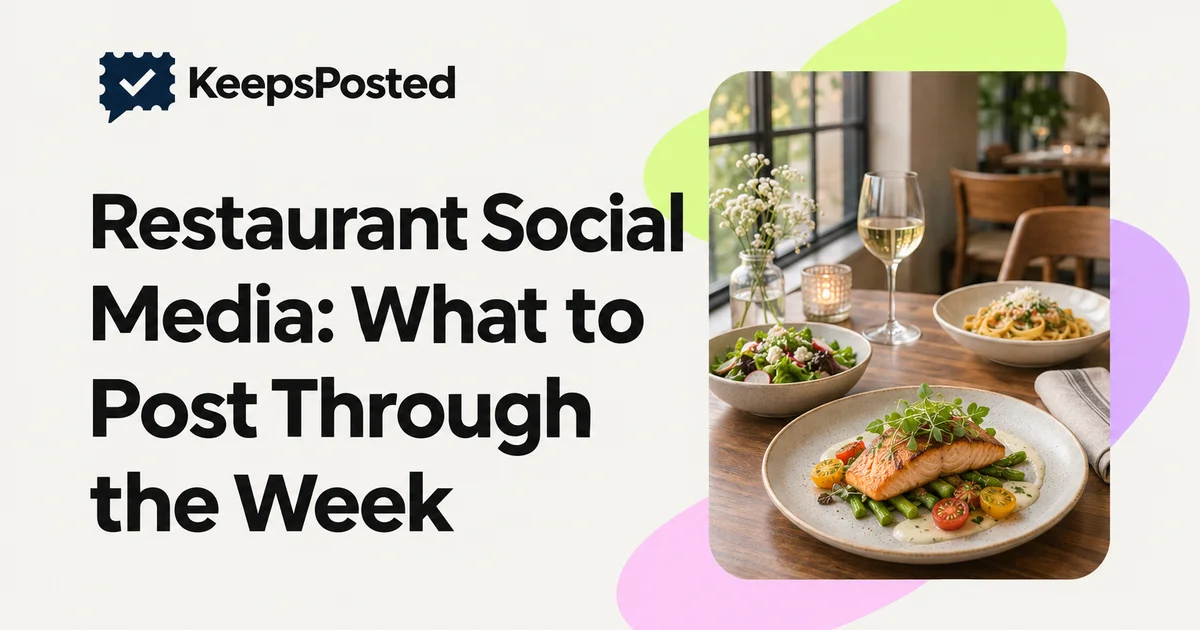
A restaurant's week is not flat. Tuesday is quiet, Friday is full, Sunday might be lunch. A good social media plan follows that shape: it fills the slow nights, tells people what is on, and answers the questions guests ask before they book.
This post gives you a seven-day service-week plan with a shot for each slot, a worked example, and a caption check for allergens, "gluten-free" and review incentives. The post ideas are practitioner suggestions, not measured results for restaurants. The rules are summarized from regulators and are general information, not legal advice.
Short answer
- Post about the shift that needs guests: slow nights, a new special, the tables still open this weekend.
- Show the kitchen and the food in motion, not only plated dishes. Hands, steam and pours are easy to shoot during prep.
- Show the price and the date on anything you want people to act on, and keep pinned posts current.
- Treat allergen and "gluten-free" wording as claims. If you cannot back it up on the day, leave it out.
- Do not offer anything in return for reviews that depends on what the review says.
A seven-day service-week plan
Adapt the days to your closed day and busiest nights. If you only have time for three posts a week, take Tuesday, Thursday and Saturday. The shot column is something you can capture during normal work in under five minutes.
| Day | Post | Shot to capture | Caption job |
|---|---|---|---|
| Monday (quiet, often closed or slow) | Prep and people | Prep station at 3 p.m.: hands, knives, a pot. No faces unless the person agrees | Tell guests what is being made today and why it takes time |
| Tuesday (slow night) | Slow-night fill | The dish or deal for the night, overhead, in the dining room's light | State the offer, the hours it runs and how to book. Put the price in the text |
| Wednesday | The kitchen | A 5-second clip: pan, sauce pour or plating, with sound | One sentence about the dish, no hype. Name the main ingredient, check allergens |
| Thursday (book for the weekend) | Booking nudge | The room before service, tables set, lit | Tell people what is still open on Friday and Saturday and where to book |
| Friday | A guest moment | A table with the food on it, no faces, or a toast with consent | Say what was served and who made it. Do not call it "the best" |
| Saturday | The special or the weekend menu | Menu board close-up with prices, readable | What is new, what is gone, what is limited |
| Sunday | Staff or story | A team photo with names and roles, only if each person agrees | One fact about the person or the place. Thank people by name only with their consent |
You do not need seven posts. Choose the slots that match what your restaurant actually does. A rhythm you can keep beats a plan that collapses in week three.
A worked example (fictional)
For example, a restaurant called Marlow Street Kitchen is quiet on Tuesday and wants to sell a three-course early menu. This is an invented example to show the workflow.
Tuesday slow-night post
Photo: the starter on the pass, overhead, daylight from the front window.
- Caption
- Tuesday early menu at Marlow Street Kitchen: starter, main and dessert for [price], served 5 to 7 p.m. Tonight's starter is [dish]. Book at [link] or call [number].
- Facts to confirm
- Price, hours it runs, what "three courses" includes, whether the offer ends on a date
- Allergen check
- The dish contains [list]. The menu for this offer is the same as the printed one. We can tell guests about the 14 (UK) or 9 (US) major allergens on request
- Claims check
- No "best", no "free" unless it is free, no health claim, no "gluten-free" unless it passes the check below
- Pinned or temporary
- Temporary. Remove or edit the post when the offer ends
Notice what the caption does: it states what, when, how much and how to book. It also leaves out anything the kitchen could not prove. That is the template for every slot in the table.
Allergens, "gluten-free" and other claims
Guests with allergies read captions closely. These are the rules and the safe habits.
- US allergens. Sesame became the ninth major food allergen on 1 January 2023 under the FASTER Act (FDA). The other eight are milk, eggs, fish, crustacean shellfish, tree nuts, peanuts, wheat and soybeans. Know where each appears in each dish.
- "Gluten-free" in the US. The FDA's gluten-free definition is under 20 parts per million, and it says restaurants that make gluten-free menu claims should follow its definition. State and local governments oversee restaurants (FDA). If your kitchen shares fryers or surfaces and you cannot say what a guest will get, do not use the phrase in a caption. Say what you can: "made without wheat ingredients; prepared in a kitchen that also handles wheat".
- UK allergens. Businesses that sell food that is not prepacked, such as meals in restaurants and cafes, have allergen-information duties; the Food Standards Agency explains them (FSA guidance). Rules for food sold by phone or online differ. Check the FSA's current page for your case.
- "Allergen-free", "safe for coeliacs", "nut-free" and "vegan". These are claims. If you cannot guarantee them, do not post them. A caption that invites guests to ask about allergens is safer than one that promises.
A practical habit: keep the allergen matrix next to your facts sheet, update it when the menu changes, and make "allergens checked against the matrix" a line on every food caption's approval.
Reviews: ask, but do not buy sentiment
Guests read reviews, and owners are tempted to nudge them. The US Federal Trade Commission's rule on reviews and testimonials says incentives for reviews are permitted only if nothing expresses or implies that the review must have a particular sentiment. A free dessert for a five-star review conditions the reward on a positive review. The FTC also says that when reviews are featured in advertising or marketing they become testimonials (FTC Q&A, read 10 November 2026).
- Fine: a sign saying "Tell us how we did" with a link to your review page.
- Fine: replying to every review in your own words, politely.
- Not fine: "Leave us five stars for a free drink", or a reward only for positive reviews.
- Check first: reposting a guest's review on your feed. Treat it as a testimonial: get permission, keep it real and unedited.
- UK: the rules on fake and hidden-incentive reviews are separate. Check the CMA's guidance if you operate there.
A reply does not have to be long. Thank them, answer the point, and invite the guest to contact you. Avoid pasting the same reply to every review.
Dates that exist, and how to label them
Pick the days that fit your menu and your guests. Skip the rest.
| When | Day | Kind | Restaurant idea |
|---|---|---|---|
| 16 October | World Food Day | Official UN observance (FAO) | A dish built on one local, seasonal ingredient, with the supplier named if they agree |
| 7 June | World Food Safety Day | Official UN observance | Show handwashing, labeling, chilled storage: how you keep guests safe |
| October (check the organizer) | International Chefs Day | Run by Worldchefs; check their site for this year's date | The chef plating a dish, with their consent |
| 28 November 2026 (US) / 5 December 2026 (UK) | Small Business Saturday | Retail event. Check the organizer for the year | A thank-you to regulars and a short "book for December" post |
| February | Valentine's Day | Marketing occasion | A set menu with the last bookable date, posted two weeks ahead |
| Varies by country | Mother's Day | Marketing occasion (UK Mothering Sunday and US Mother's Day are on different dates) | A brunch menu with a booking cut-off |
Label marketing days as what they are. "National Burger Day" style dates come from commercial calendars, not governments, and it is honest to say so or to skip them. The official UN list is the source for the UN days (UN international days, checked 10 November 2026).
A 10-minute capture routine during service prep
Before the doors open
Dining room from the entrance, tables set, light on. One wide shot and one close-up of a table setting.
During prep
One clip of hands working: slicing, plating practice, a pour. Clip it at five seconds.
At the pass
The dish you most want to sell tonight, overhead, on a clean plate. Wipe the rim.
At the menu board
A readable shot of the board or printed menu with prices.
At the door
A photo of the opening hours sign, so the hours in your posts match the door.
Keep the shots in one folder named by date. A drafting tool such as KeepsPosted can suggest the week's posts from the photos and facts you supply, but you still check allergen and claim wording before approving.
Common mistakes
- A pinned post with last season's menu or prices.
- "Allergen-free" or "gluten-free" on food from a shared kitchen with no way to guarantee it.
- A "free dessert for 5 stars" offer.
- Reposting a food blogger's photo without permission or a clear tag.
- Showing guests' faces without asking.
- Heavily edited food photos that make the portion look larger than what arrives.
- Posting alcohol content without checking local advertising rules and the platform's policies.
For stale facts across your whole page, see audit your last 30 posts. For a café that runs a different day, see café social media.
Common questions
How often should a restaurant post?
As often as you can keep up. Three well-chosen posts a week is a realistic starting point for a busy kitchen. We do not have measured data on the ideal number for restaurants.
Can a restaurant use "gluten-free" in a caption?
In the US the FDA says restaurants that make gluten-free menu claims should follow its definition of under 20 parts per million. If you cannot ensure that in your kitchen, do not use the phrase. Check your local food authority.
Can we offer a discount for leaving a review?
Not one that depends on a positive review. The US FTC rule bars incentives that express or imply a required sentiment. Ask for reviews without a reward tied to the rating, and check local rules.
Sources
- FDA: FASTER Act, sesame as the ninth major food allergen (checked 10 Nov 2026)
- FDA: Gluten-free means what it says (checked 10 Nov 2026)
- UK Food Standards Agency: allergen information for non-prepacked foods (checked 10 Nov 2026)
- FTC: Consumer Reviews and Testimonials Rule, questions and answers (checked 10 Nov 2026)
- United Nations: list of international days and weeks (checked 10 Nov 2026)
- Small Business Saturday UK (checked 10 Nov 2026)
Written by the KeepsPosted editorial team from regulator and organizer pages listed above, with AI assistance for drafting and a person reviewing every claim. The weekly plan is practitioner consensus, not measured results. The worked example is fictional. This is general information, not legal advice.
Keep reading

Café Social Media: A Dated Plan for Coffee and Pastry
Shot ideas by time of day, a four-week café calendar with real dates, and caption checks for allergens and "gluten-free" in a shared kitchen.
Bakery Social Media: Pre-Orders, Sell-Outs and Seasons
A pre-order countdown sequence for custom cakes and holiday bakes, what to post when you sell out, and allergen wording for packed items.
Can You Repost Customer Reviews and Photos? The Rules
When a customer review or photo on your feed becomes a testimonial, what consent you need, and what the FTC and UK rules say. With wording you can copy.