Café Social Media: A Dated Plan for Coffee and Pastry
Shot ideas by time of day, a four-week café calendar with real dates, and caption checks for allergens and "gluten-free" in a shared kitchen.
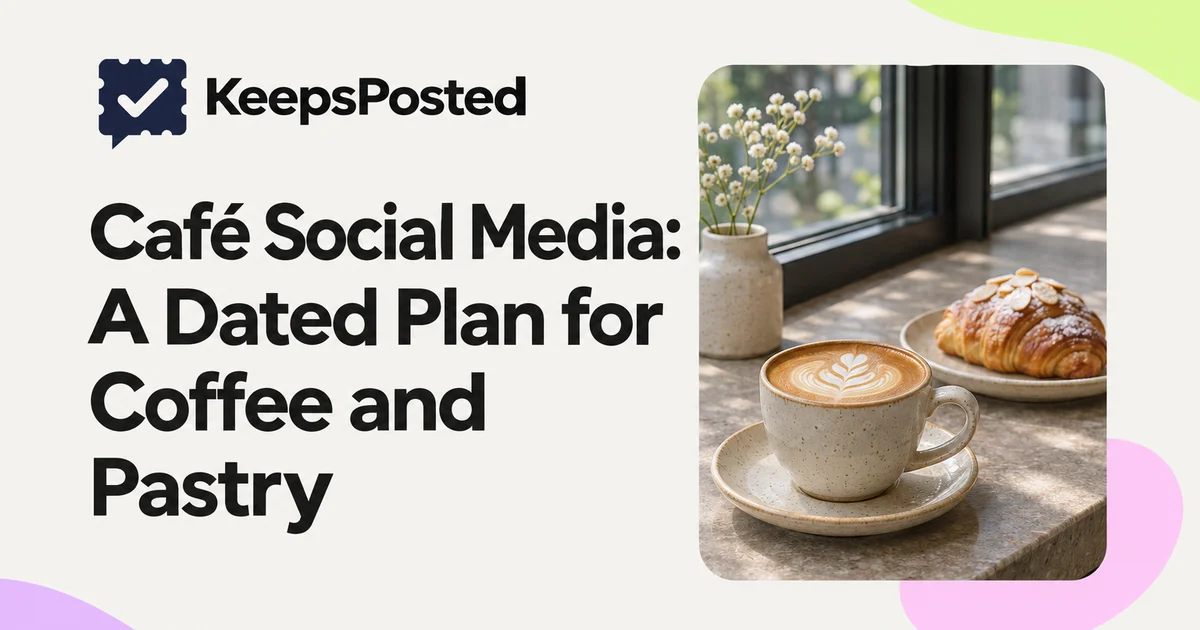
A café does not sell a dinner reservation. It sells a habit: the first coffee of the day, the pastry on the way to work, the table for an hour on Saturday. Social media works for a café when it follows the day, from the first pour to the last sandwich, and when the menu, price and hours in every post are still true.
This guide gives you a time-of-day shot list, a four-week calendar that you can fill with the dates below, and an expiry workflow for menus and prices. The post ideas are practitioner suggestions, not measured results. The allergen points are summarized from regulators and are general information, not legal advice.
Short answer
- Shoot by time of day: opening, morning rush, midday, afternoon, close. Each has a different shot and a different job.
- Run a simple four-week cycle: a regular drink, a food item, a person, and a fact (hours, closure, supplier).
- Use dates that exist, and label them honestly. International Coffee Day (1 October) is on the UN list; "National Coffee Day" in the US is a marketing day.
- Give every price, special and seasonal item an end date, and remove or edit the post when it passes.
- Treat "gluten-free", "vegan" and "nut-free" as claims. A shared kitchen can make them hard to promise.
A time-of-day shot list
| Time | Shot | Caption job |
|---|---|---|
| Before opening | The empty room, lights on, chairs down, the pastry case being filled | Say the opening time and anything new today |
| Opening | The first pour or a latte-art pour from above. Hands only is fine | A drink, its price and what is in it |
| Morning rush | A short clip of the queue or the counter. Blur faces or get consent | "Open until [time], here is what is left" and a reminder of today's special |
| Midday | A lunch item, a sandwich or soup, on the counter with the price card | What is on, what it contains, how long it lasts |
| Afternoon | A window seat, a table with a laptop and a cup (no faces), a slice of cake | A reason to come back: a quiet hour, a seasonal item |
| Close | The pastry case at the end, or the chalkboard for tomorrow | Tomorrow's hours or a line on what sold out |
One shoot of about 15 minutes during a quiet moment can cover a month of captions if you capture a handful of angles of each item. Keep the photos in a folder by item, with the date, and delete anything you do not want to use.
A four-week café calendar
Use this as a repeating four-week cycle. Each week has four post slots: a drink, a food item, a person or place, and a fact. Add one or two dated hooks from the next section where they fit. Three posts a week is enough if you cannot manage four.
| Week | Drink | Food | Person or place | Fact |
|---|---|---|---|---|
| 1: the regular | Your best-selling drink, shown being made | The pastry or bake people ask for by name | The person who makes it, with their agreement | Hours, including any change this week |
| 2: something new | A new or seasonal drink, with the price and an end date | A new bake, with ingredients and allergens | A supplier or roaster, named with their agreement | How to order ahead, if you offer it |
| 3: the room | A non-coffee option: tea, hot chocolate, a cold drink | A lunch item with the price | The room: seating, laptop-friendly tables, children's corner | Wi-Fi, accessibility, parking, bike racks |
| 4: the community | A drink linked to a dated hook, if one fits | A sharing item, a box or a gift | A regular, with consent, or a local partner | Holiday hours or closures for the next month |
After four weeks, look at which slots got comments, saves and visits, and which got nothing. Keep the first group, rework the second. We do not have a measured benchmark for cafés, so your own page is the best data.
Dates that exist, and how to label them
| Date | Day | Kind | Café idea |
|---|---|---|---|
| 30 March | International Day of Zero Waste | UN observance | Show your reusable-cup discount or how you handle coffee grounds |
| 21 May | International Tea Day | UN observance (FAO) | Feature your tea: where it comes from, how it is brewed |
| 5 June | World Environment Day | UN observance | A reusable-cup post. State the actual discount, if you give one |
| 20 May | World Bee Day | UN observance (FAO) | A honey-based drink or bake, if you serve one |
| 29 September | US "National Coffee Day" | Marketing day, not an official observance; its origin is disputed | Say "a popular coffee day" if you join in, and give a real offer |
| 1 October | International Coffee Day | UN list of international days | Your origin story, the roaster, the farmer's region, if you know them |
| 28 November 2026 (US) and 5 December 2026 (UK) | Small Business Saturday | Retail event; check the organizer for the year | A thank-you to regulars and a gift-card post |
The UN dates come from the UN list of international days, checked 10 November 2026. Variable-date events change each year, so check the organizer's own page. Leave out any "National [Food] Day" that you cannot trace to a real organizer, or label it as a hashtag day.
An expiry workflow for menus, prices and specials
Stale information is the most common café mistake: yesterday's special still pinned, last season's price in a caption, hours that changed in the autumn. A simple expiry habit fixes most of it.
Give every special an end date
Write it in the caption and in your note. "Pumpkin latte, until 30 November".
Put the end date in a list
One sheet with the post, the item, the price and the end date.
Review on a fixed day
Every Friday, check the sheet. Anything ended gets deleted, archived or edited.
Keep price changes together
When a price changes, search your last 30 posts for the old price and edit them.
Pin carefully
Pin only posts that do not expire: hours, how to find you, a standing offer you have no plan to end.
If a drafting tool such as KeepsPosted helps you plan the week from your photos and facts, add the end date to the facts you give it, so the caption states it. The check on Friday is still yours.
Allergens, "gluten-free" and shared kitchens
- US. Sesame became the ninth major food allergen on 1 January 2023 (FDA). The FDA defines gluten-free as under 20 parts per million and says restaurants making gluten-free menu claims should follow that definition (FDA). Packaged items sold at a café may follow labeling rules. Check your local authority.
- UK. Non-prepacked food, such as drinks and pastries made and sold on site, has allergen-information duties (FSA guidance). Food packed on the premises before the customer orders is called prepacked for direct sale, sometimes called Natasha's Law, which needs a full ingredient list with allergens emphasized (FSA page on PPDS). The rule has applied since October 2021, but the FSA page we read did not state the start date, so check the FSA for the current requirement.
- Claims. A caption that says "gluten-free brownie" is a claim. If the brownie is baked on the same trays as wheat pastries, you may not be able to promise it. Say what you can state: "made without wheat flour. Our kitchen also handles wheat, so it may not suit coeliacs." Plant-based milk, "vegan" and "nut-free" work the same way.
Mistakes to avoid
- A "gluten-free" bake made in a shared kitchen with no way to guarantee it.
- Stale hours or old holiday closures on the page and on Google.
- Trending audio that buries the product and the price.
- A stock photo of coffee you do not serve.
- Showing a regular without asking.
- Calling a marketing day an official observance.
For a dinner restaurant with a different weekly rhythm, see restaurant social media. For a bakery that sells by pre-order, see bakery social media.
Common questions
How often should a café post?
Start with three posts a week and one short clip. There is no measured number for cafés, so judge by what your own followers respond to.
Is National Coffee Day an official holiday?
The US "National Coffee Day" on 29 September is an industry and marketing day with disputed origins. International Coffee Day on 1 October is on the UN list of international days.
Can I call a drink or cake gluten-free in a shared kitchen?
It depends on whether you can meet your local definition. In the US the FDA definition is under 20 parts per million. If you cannot guarantee that, describe the ingredients and mention the shared kitchen instead.
Sources
- United Nations: list of international days and weeks (checked 10 Nov 2026)
- FDA: FASTER Act, sesame as the ninth major food allergen (checked 10 Nov 2026)
- FDA: Gluten-free means what it says (checked 10 Nov 2026)
- UK Food Standards Agency: allergen information for non-prepacked foods (checked 10 Nov 2026)
- UK Food Standards Agency: introduction to allergen labelling for PPDS food (checked 10 Nov 2026)
- Small Business Saturday UK (checked 10 Nov 2026)
- Cook's Info: National Coffee Day (origin disputed) (checked Not re-read on 10 Nov 2026; secondary source)
Written by the KeepsPosted editorial team from the UN, FDA and Food Standards Agency pages listed above, with AI assistance for drafting and a person reviewing every claim. The calendar and shot list are practitioner consensus, not measured results. This is general information, not legal advice.
Keep reading
Restaurant Social Media: What to Post Through the Week
A week of Instagram and Facebook content for a restaurant: specials, slow-night fills, kitchen shots, allergen-aware captions and review incentives to avoid.
Bakery Social Media: Pre-Orders, Sell-Outs and Seasons
A pre-order countdown sequence for custom cakes and holiday bakes, what to post when you sell out, and allergen wording for packed items.
A Local Business Social Media Calendar With Real Dates
Plan 12 months of Instagram and Facebook posts around dates that exist: verified observances, local seasons and your own events. With a blank four-week grid.